

Ion science at the service of tomorrow’s space industry
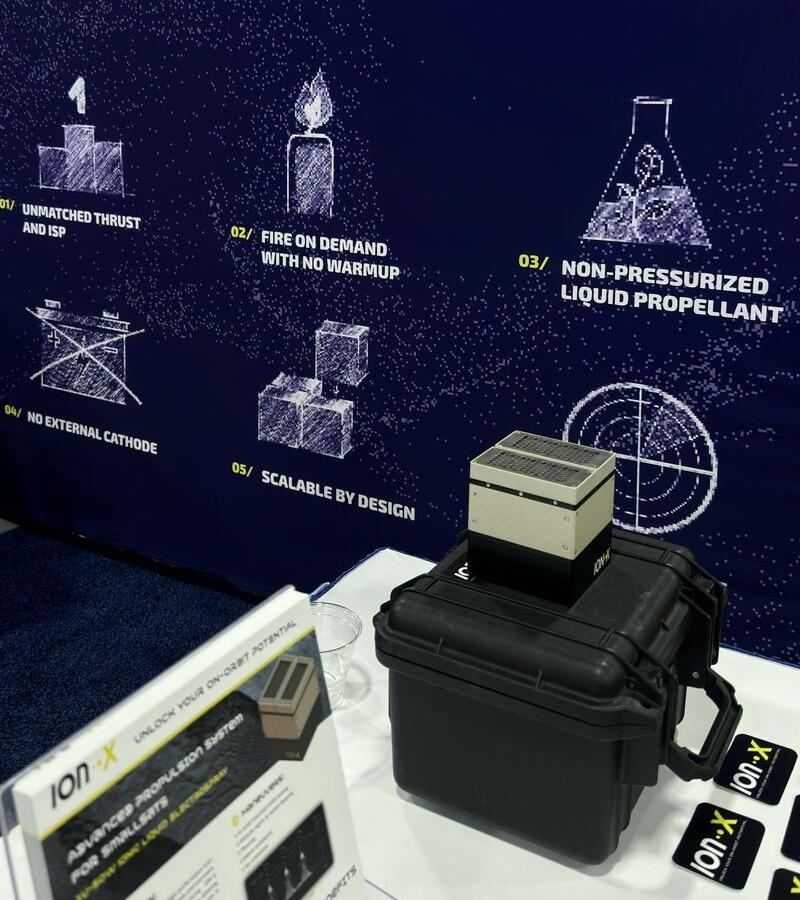
By betting on a new generation of electric propulsion, ION-X aims to give small satellites greater autonomy and agility while reducing their dependence on the major space powers. Born of a partnership between Technofounders and the CNRS, the startup is exploring a technological approach that long remained in the shadows: electrohydrodynamic ion propulsion, where precision matters as much as power.
Better propulsion without reinventing everything
In the world of small satellites, every gram counts. So does every watt. It is in this delicate balance that ION-X operates.
“Our thruster seeks the best trade-off between thrust, power consumption and overall efficiency,” explains Thomas Hiriart, the startup’s CEO.
The technology is based on an electrohydrodynamic principle: ions are extracted from a conductive liquid, then accelerated to produce continuous thrust with minimal energy consumption. Nothing chemical or explosive here: propulsion relies on precision work, powered by the solar energy generated by the satellite itself. The thruster thus remains compact, efficient and perfectly suited to the constraints of low Earth orbit, where satellite density keeps increasing.
“Today, small satellites perform the same functions as large ones. The difference is that they cost less to build and launch.”
Thomas Hiriart, CEO of ION-X
A liquid propellant and fewer constraints
ION-X has also made a bold choice regarding its propellant: no gaseous xenon and no pressurised tanks. Instead, the company uses a non-toxic, locally available ionic liquid.
“It is a fluid we buy in France from industrial suppliers. It is easier to store, safer and less expensive than conventional alternatives,” explains Thomas Hiriart.
Behind this technical choice lies another issue: simplifying logistics while meeting the space sector’s new expectations in terms of safety, environmental impact and industrial sovereignty. As small satellites multiply and become indispensable for many uses (Earth observation, connectivity, geolocation), their ability to move in orbit is becoming strategic.
Space on an industrial scale
A former member of CNES, NASA and ArianeGroup, Thomas Hiriart was also a consultant at BCG. A career at the crossroads of science and strategy that he now puts to work structuring an industrial project. Since his arrival, ION-X has completed two funding rounds, including a Series A in 2024, with the support of the European Commission, Expansion, Innovacom and Technofounders.
The first ION-X thruster was placed in orbit in early 2025 aboard a Danish satellite launched by SpaceX. The goal: six months of testing in real conditions to validate its performance. In parallel, an assembly plant is planned in the Paris region to support the scale-up. Industrialisation is under way, the ION-X way: efficiently, methodically, quietly.
A strategic issue
Against a backdrop of geopolitical tensions and growing technological dependencies, the question of space mobility is taking on a new dimension.
“Without satellites, we would go back to the Stone Age,” Thomas Hiriart points out. Weather, navigation, maritime surveillance, agriculture, telecommunications: space infrastructure underpins our daily lives, often without our being aware of it. ION-X does not claim to revolutionise everything. But by offering a lightweight, modular and efficient solution, the startup is helping to strengthen a European space ecosystem still too dependent on foreign standards.
Propelling differently is also a way of taking back control.