

From laboratory to industry: the promise of synthetic diamond with HiQuTe Diamond
The physical properties of diamond are now opening up prospects in several fields, from power electronics to quantum technologies and sensing, with energy efficiency gains at stake and a sovereignty issue for Europe. But several technological and industrial bottlenecks still need to be overcome for these applications to scale up.
Florent Alzetto, CEO of HiQuTe (a spin-off of the LSPM-CNRS laboratory), discusses the potential of this material and the challenges of industrialising it.
A material with extraordinary properties
The appeal of diamond lies first of all in the combination of its physical properties.
Its thermal conductivity, five times that of copper and more than ten times that of silicon, allows it to dissipate heat efficiently. Its wide band gap (five times that of silicon) also offers prospects for going beyond the performance of the materials currently used in certain applications, particularly power electronics: its very high breakdown voltage makes it possible to design thinner, less resistive components, which therefore lose less energy as heat during conversion.
Added to these characteristics are its quantum properties at room temperature. In the quantum field, they make it possible to limit cooling requirements and develop more compact devices.
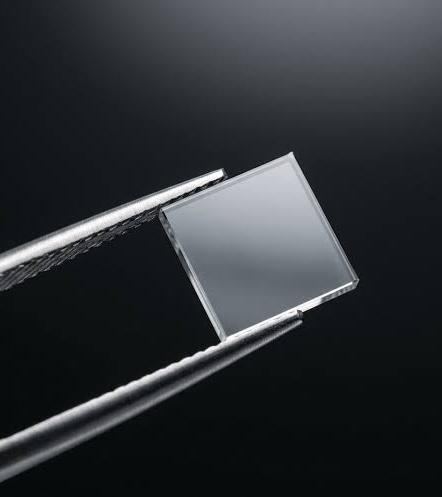
In practical terms, the industrial diamond produced by HiQuTe comes in the form of very thin wafers, comparable in shape to a small plate of glass. Current dimensions are around 20 × 20 mm for a thickness of less than a millimetre.
Making diamond an industrial material
Ten or so years ago, diamond’s performance was still largely confined to the laboratory scale, with high production costs for the industrial players, who could be counted on the fingers of one hand. Since then, dozens of startups in Europe, North America and Asia-Pacific developing applications based on its properties (magnetometry, chip imaging, quantum computing) have brought new products to market, seen their sales grow and, in some cases, reached profitability.
For HiQuTe, the challenge now is to reduce costs, increase volumes and prepare the developments needed for future applications, particularly in semiconductors, for which Florent Alzetto is aiming for commercialisation in around five years.
One of the main technological bottlenecks concerns wafer size. To eventually serve the electronics market, the goal is to reach at least 5 cm for manufacturers’ R&D needs, then 10 cm to move into production.
“Size is the crux of the matter. Without it, there will be no diamond power electronics.”
Florent Alzetto, CEO of HiQuTe
This scale-up also poses real industrial challenges: these wafers, which will remain very thin, will need to be handled, cut, polished and shaped according to customers’ needs.
What diamond already makes possible
In sensing, some of HiQuTe’s customers are developing sensors capable of measuring magnetic fields of the order of a nanotesla. Such precision can in particular be used to measure variations in the Earth’s magnetic field in order to determine position very accurately.
In semiconductor foundries, these technologies can also be used to locate leaks or certain defects on chips and to optimise the yield and throughput of production lines.
Finally, diamond is of interest for quantum computing. Its properties at room temperature open the way to compact quantum accelerators, potentially integrated into larger systems.
“The advantage of diamond is miniaturisation. We can operate at room temperature, so we will not need large cooling systems.”
Florent Alzetto, CEO of HiQuTe
Building a strategic industry
“Diamond took ten years to leave the laboratory. The next ten years will decide whether it becomes an industrial material like silicon, and whether Europe masters it.”
Florent Alzetto, CEO of HiQuTe
For Florent Alzetto, the development of diamond is also a matter of sovereignty. Given Europe’s dependence on imports of materials such as silicon and gallium, diamond could be an alternative material produced in France from methane and electricity.
Its properties could also reduce the amount of energy needed to deliver the same service, particularly in communications infrastructure and electric vehicles. For the latter, Florent Alzetto mentions an expected reduction in consumption of around 10%.
Finally, this trajectory will require collaboration with other players, particularly for certain steps such as cutting and shaping the wafers, as well as investment to continue development.